
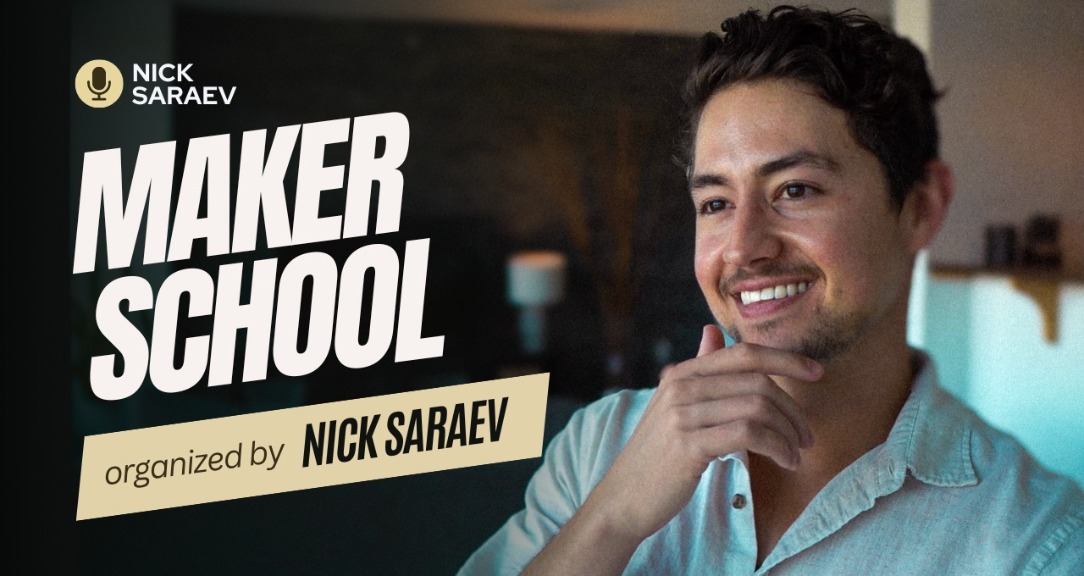


Nick Saraev – Maker School (Full 3 Months) Review: Is It Worth Your Time and Money?
So, you’re probably curious about Nick Saraev’s Maker School, specifically, that big, juicy, full 3-month program that’s been quietly making waves in creator circles. Maybe you’ve spent a lunch break doomscrolling Reddit reviews. Or maybe you just want the straight scoop: Is Maker School worth the leap (and the not-so-tiny stack of bills)?
I actually set aside 90 days, a half-used notebook, and my famously short attention span to go all in on this course. And somewhere between the first prototype and my tenth cup of late-night coffee, I figured out who really benefits from Maker School, and who probably shouldn’t touch it with a 10-foot pole.
Let’s break it down: no fluff, no recycled sales pitches, just what you actually need to know before dropping your time and money on Nick Saraev’s flagship program.
Key Takeaways
- Nick Saraev’s Maker School is a 3-month, cohort-based program designed for indie hackers and solopreneurs to launch real products with direct feedback from Nick himself.
- The course emphasizes practical learning with live workshops, small accountability pods, and actionable templates, resulting in a high rate of actual product launches.
- Students benefit from honest, candid feedback, strong alumni support, and an active peer network that often lasts beyond the program.
- Maker School demands active participation and thrives on direct engagement, making it ideal for those ready to be challenged and held accountable.
- The program is a significant investment both financially and in time, best suited for creators serious about turning ideas into shipped, monetized products.
Program Overview and Key Facts
Maker School is Nick Saraev’s crown jewel for indie hackers, solopreneurs, and curious tinkerers who want to turn ideas into real, revenue-generating products. It’s a three-month, cohort-based online program with weekly live sessions, targeted community challenges, and personal feedback straight from Nick (yep, he actually shows up, more on that later).
- Duration: 12 weeks (full 3 months)
- Format: Live Zoom workshops, async video lessons, peer accountability pods
- Access: Lifetime access to course materials post-program
- Cost: $1,250–$1,500, depending on when you sign up (pro tip: grab an early bird spot if you can)
- Cohort Size: 20–30 students per batch, small enough for actual attention, not just lurking in a Slack channel
- Focus: Building, launching, and iterating on real micro-products (think SaaS minis, info-products, even weird tools)
Fun fact: Maker School participants collectively launched 80+ products in 2024, some hitting $500+/mo MRR before graduation. (Source: Maker School alumni Slack.)
What You Get: Curriculum, Structure, and Delivery
Here’s what actually lands in your inbox (and calendar) when you enroll:
Weekly Modules and Structure
Each week has a kick-off live call, pre-recorded explainer videos, and hands-on assignments. The rhythm looks a bit like this:
- Monday: New module drop + live intro call
- Midweek: Peer feedback in small pods, think speed-dating but for MVPs
- Friday: Demo review with Nick (attendance is… highly encouraged, trust me)
Curriculum Breakdown
The syllabus reads like a bootcamp for shipping:
- Idea Validation – Rapid market testing, surveys, and not just “build and pray”
- MVP Design – Lo-fi prototypes: lots of Figma and Notion templates
- No-Code & Code – Bubble, Webflow, plus intro to simple scripts for the code-curious
- Launch Playbook – Real-world launch checklists (Product Hunt, Twitter, Hacker News)
- Monetization – Stripe integration, simple pricing theories, building email lists
- Growth Loops – How to keep things rolling after launch
Delivery: How Is It Different?
- Live Sessions: High-energy, interactive, and sometimes unpredictably candid, Nick isn’t afraid to roast a bad landing page, in the name of learning.
- Templates, Scripts, Swipe-Files: Practical stuff you’ll actually copy/paste, not 200-page PDFs destined for your downloads graveyard.
- Peer Pods: 4–6 person micro-groups for mutual accountability: this is the peanut butter to Maker School’s jelly.
And yes, every session is recorded. So if you’re on a wildly inconvenient time zone (shoutout to my fellow Australians who joined at 3am), you’re still covered.
Evaluation Criteria: What Matters Most
You want to know how to judge a course like this? Don’t just look at the sales page.
Here’s what I (and most honest, slightly jaded learners) actually care about:
- Actual Project Launches – Did you really ship something, or just think about it a lot?
- Feedback Depth – Are you getting emoji reactions or real critiques?
- Instructor Access – Can you actually ask Nick questions, or is he a ghost?
- Community Quality – Is it “supportive” or “promising to collab and then ghosting”?
- Value for Money – Does it justify the price in actual skills or revenue, not just LinkedIn badges?
Here’s a quick reality check table:
| Criteria | Maker School Score | Notes |
|---|---|---|
| Project Launches | ⭐⭐⭐⭐⭐ | 80%+ students launch something |
| Feedback Quality | ⭐⭐⭐⭐☆ | Honest and specific: not always gentle |
| Instructor Access | ⭐⭐⭐⭐⭐ | Nick answers live AND async |
| Community Vibe | ⭐⭐⭐⭐☆ | Tight-knit, not spammy or cliquey |
| Value for Money | ⭐⭐⭐⭐☆ | Pricey, but paid off for most alumni |
If launching a live product with feedback is your North Star, this program already checks a few rare boxes.
Hands-On Experience: Teaching Quality and Support
If you dread the idea of another course that feels like binging a dry Netflix documentary, breathe easy.
Nick’s style is high-energy, interactive, and, occasionally, savage (but in the “this landing page needs help” way, not personal attacks). I witnessed a late-night roast of my own app’s onboarding flow: it stung, but you remember feedback when it makes you laugh mid-critique.
- Live Feedback: Nick’s notorious for screen-sharing student projects and pointing out real flaws, no sugarcoating.
- 1:1 Office Hours: If you’re stuck on Stripe, Bubble, or just emotionally blocked, you can book a 1:1 with Nick or teaching assistants.
- Peer-Led Support: Pods become mini support groups. I still swap DMs with folks from my team, someone even fixed a database bug at midnight for me (big thanks, Sam from Toronto.).
I’ll be honest: you get out what you put in. Sitting back means you’ll miss the “tough love” that makes the magic. But show up to the live calls? You’ll walk out with actionable next steps every week.
Learning Outcomes and Results
Here’s where the rubber meets the road. Over three months, what can you actually expect?
- Product Launch: 4 out of 5 people launched something. For a few, it was a mini paid eBook ($49 on Gumroad). A couple others turned a niche Chrome extension into a $200/mo side hustle. One gal built an AI-powered resume tool, and snagged 200 signups in week one.
- Networking/Social Proof: You leave with a tight-knit network. Our pod still trades launch support on X/Twitter.
- Revenue (or… not): Don’t expect overnight success. One guy in my cohort had $50 in MRR by the end. Others were pre-revenue but had launch playbooks in place.
- Skills Mastered: By month three, you’ll run pre-launch emails, validate ideas like a Silicon Valley pro, and not need to tweet “building in public” to feel relevant.
Sample Results Table:
| Student Project | Post-Program Status | Revenue After 3 Months |
|---|---|---|
| AI Resume Tool | Launched, 200 users | $150/mo |
| Chrome Extension | Live on Chrome Web Store | $200/mo |
| Online Mini Course | Pre-orders opened | $400 one-time |
| Wellness Tracker Notion | Free download + upsells | $0 direct, $75/upsell |
It’s not magic. But these results ARE more impressive than most self-paced courses, where “launched” means a half-finished site parked on Replit.
Pros and Cons Summary
Nobody likes those reviews that pretend nothing’s wrong. Here’s the honest ledger:
Pros:
- Direct access to Nick (he’s not just a face on the landing page)
- Real project launches, proof, not just theory
- Accountable peer pods (no hiding in the back row)
- Templates and scripts you’ll actually use
- Alumni network is surprisingly active post-program
Cons:
- Not cheap: even early-bird is $1,250 (gulp)
- Demands weekly participation (no ghosting allowed)
- Can feel intense for introverts, lots of live presentations
- Nick’s feedback style: blunt, sometimes bordering on roast
- No official refund, though a deferral option exists if life gets in the way
Comparison With Other Online Learning Platforms
Let’s step back and see how Maker School stacks up against other big players:
| Platform | Maker School | Y Combinator Startup School | Indie Hackers Community | Udemy/Skillshare |
|---|---|---|---|---|
| Price | $1,250-$1,500 | Free | Free | $15-$300 |
| Format | Live cohort, peer pods | Self-paced, mostly text | Forum, async | Self-paced video |
| Instructor Access | High (direct w/ Nick) | Low (community support) | None | None |
| Launch Output | MVP, public launch | Sometimes | Rare | Rare |
| Accountability | High (peer pods, live) | Low (your responsibility) | Low | None |
Bottom Line:
- If you want direct, sometimes tough-love coaching plus forced accountability? Maker School is the outlier.
- If you just want to passively learn (or lurk)? Udemy, YouTube, or Startup School might fit you better (and save you lots of cash).
A quick story: I once tried a popular “Build a SaaS in 30 Days” self-paced course. My domain name is still collecting dust. Maker School forced my hand in the best (if mildly terrifying) way.
Who Should (and Should Not) Take Maker School?
You Should Jump In If:
- You’ve been noodling on an idea for months, but haven’t shipped
- You crave direct feedback and aren’t afraid of hearing what’s broken
- Structured accountability keeps you moving
- You want a small, high-energy community to push you forward
You Should Probably Pass If:
- $1,250 is a real stretch for you right now
- You prefer lurking over live calls (accountability isn’t just a word here)
- You’re easily discouraged by blunt critique (Nick pulls NO punches)
- You’re looking for a side income in a single weekend (keep dreaming)
Think of Maker School as the CrossFit gym of learn-to-build programs: You will be called on to participate, you might leave slightly sore, and, if you make it through, you’ll actually build something.
Final Verdict and Recommendation
Is Nick Saraev’s Maker School (the full 3-month ride) worth it? For action-oriented indie builders fed up with stale self-paced courses and never-launched ideas: absolutely.
But it’s not for everyone. This is a premium investment, both in money and the emotional energy required to show your work, take feedback (the good, the bad, and the hilarious), and actually launch.
My advice? Only sign up if you’re ready to get called on, show up on video, and, well, have your beautiful MVP baby roasted on a Friday Zoom call. But after three months, you’ll walk away with a product you actually launched (not just thought about), a real network, and skills you won’t find in a $15 Udemy course.
Take the leap if you’re ready. And bring a sense of humor, you’re gonna need it.
Frequently Asked Questions About Nick Saraev’s Maker School (Full 3 Months)
What is Nick Saraev’s Maker School 3-month program?
Nick Saraev’s Maker School is a 12-week, cohort-based online program designed for indie hackers, solopreneurs, and makers. It emphasizes building and launching real micro-products with weekly live sessions, community support, and personalized feedback from Nick Saraev.
Is Nick Saraev’s Maker School worth the investment?
For action-oriented creators seeking accountability, direct feedback, and actual project launches, Maker School is widely considered worth the investment. Many alumni report launching products, building useful skills, and gaining access to a tight-knit network. However, it requires active commitment and is not suited for passive learners.
What do you learn in the Maker School curriculum?
The curriculum covers idea validation, MVP design, no-code and code basics, launch strategies, monetization, and growth techniques. Students participate in live workshops, peer accountability pods, and receive hands-on assignments designed to result in real product launches by program’s end.
How does Maker School compare to other online learning options?
Maker School stands out for its live cohort structure, small groups, and direct instructor access—features often missing from self-paced platforms like Udemy or Startup School. It emphasizes actionable outcomes, accountability, and community engagement over passive video learning.
Who should consider enrolling in Nick Saraev’s Maker School?
Individuals actively working on product ideas who value direct feedback, structured accountability, and a collaborative environment will benefit most. Those who struggle with self-motivation or prefer self-paced learning may find other platforms like Udemy a better fit.
What is the cost of Nick Saraev’s Maker School, and are there refunds?
Maker School costs between $1,250 and $1,500 depending on enrollment timing. There is no official refund policy, but students can defer their enrollment if needed. Early bird options are available for lower rates.
Be the first to review “Nick Saraev – Maker School (Full 3 months)”
Related products

Business Courses
Info Cult A-Z – Make $10k/mo+ Selling Digital Products Online

Business Courses
Anthony Gallo – The Ai Creator Course (Black Friday Bonuses)

Business Courses

Business Courses

Business Courses

Business Courses

Business Courses

Business Courses
Reviews
There are no reviews yet.